
· Sangamesh Murgad · Operations Transformation · 6 min read
Experience Is Quietly Running Your Business — And That’s a Risk Leaders Can’t Ignore
Learn why relying on individual experience creates hidden operational risk—and how resilient enterprises are transforming toward process-led execution.
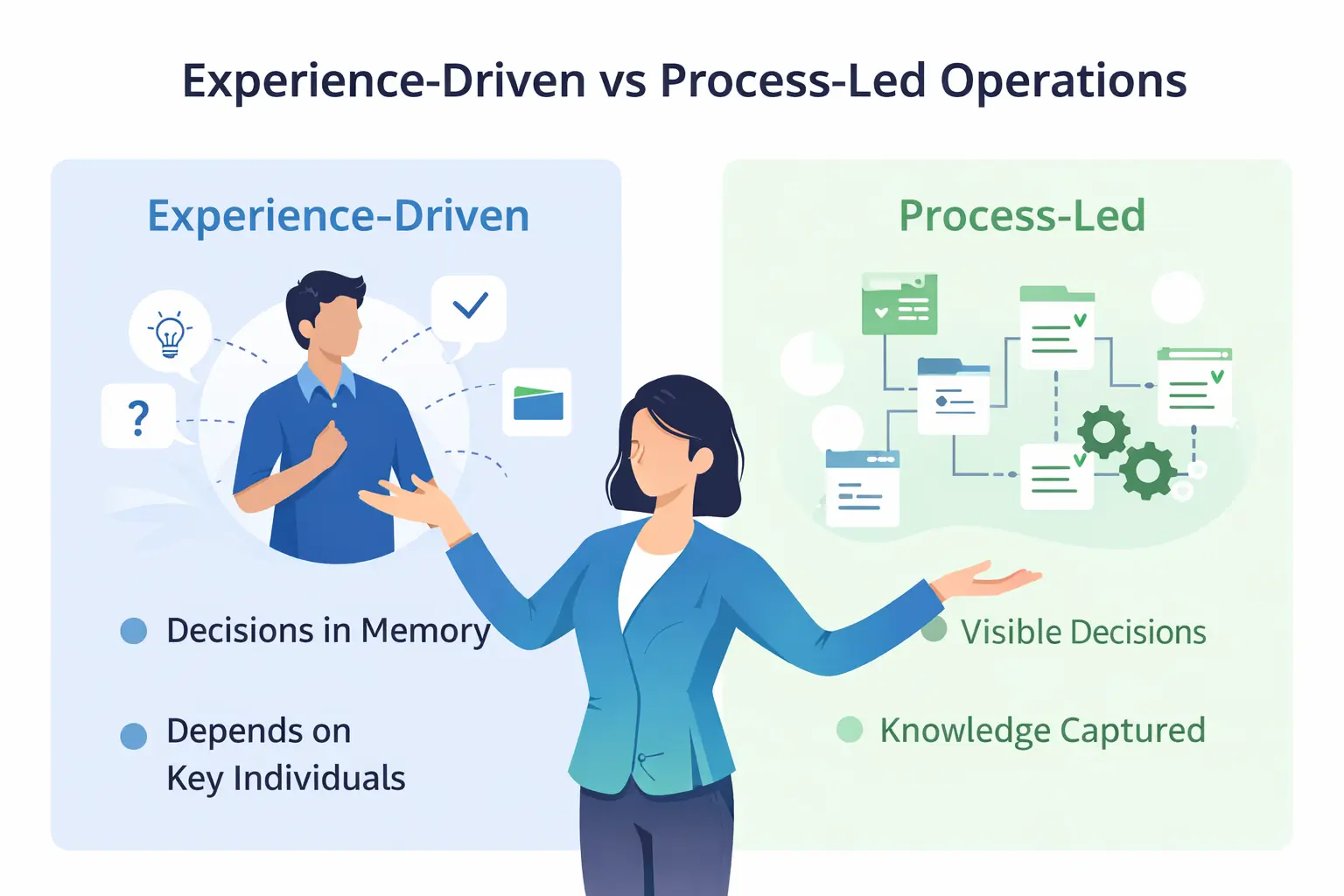
The Invisible Operating System Inside Every Business
In many multi-branch organizations, the most important “system” is not an ERP, a CRM, or an accounting platform. It is experience.
Someone who knows which vendor can be trusted. Someone who knows when to bypass an approval. Someone who knows how to “get things done” when the official process slows down. This invisible operating system often delivers results. Deals close, payments go out, materials arrive on time, and customers remain largely unaware of the internal complexity. For years, this reliance on experience feels efficient, even elegant. The organization learns to move through intuition rather than instruction. But this system has a flaw that only reveals itself under pressure.
The day that person is unavailable—on leave, transferred, promoted, or exits unexpectedly—the process slows. Decisions stall. Exceptions pile up. What once looked like speed now looks like fragility. Strong operations are not built on heroics. They are built on processes that do not depend on memory.
This article critically evaluates the hidden cost of experience-driven operations, why organizations unconsciously reward them, where they fail at scale, and how leaders can transition from hero-based execution to resilient, process-led operations without destroying the practical wisdom that made the business successful in the first place.
01 - Why Experience Becomes the Default System
Growth Outpaces Design
Most organizations do not choose to run on experience. They drift into it. A business starts small. Early employees wear multiple hats. Processes are informal, flexible, and adaptive. Decisions are made through conversations rather than workflows. This stage rewards speed and improvisation.
As the organization grows—adding branches, vendors, compliance requirements, and layers of management—the original operating model quietly breaks. However, instead of redesigning how work flows, companies patch the gaps with people who “know the way things really work.” Experience becomes the glue holding mismatched systems together.
Experience Feels Cheaper Than Design
Designing processes takes time, discipline, and often uncomfortable conversations. It requires documenting edge cases, defining ownership, and confronting inconsistencies that experience conveniently smooths over.
Relying on experienced individuals feels cheaper:
In reality, the cost is merely deferred—and compounded.
Cultural Reward for Firefighting
Organizations unintentionally glorify heroics. The person who bypasses procurement to save a deal. The manager who personally calls finance to release a payment. The operations head who “fixes” issues late at night. These actions are celebrated as commitment and ownership. Over time, the culture learns that bending the process is how results are achieved. The process itself becomes optional, even performative.
02 - The Illusion of Efficiency
Experience Optimizes Locally, Not Systemically
An experienced employee optimizes for the immediate situation:
These local optimizations make sense in isolation. However, they create invisible divergence across the organization. Each branch, department, or manager develops its own “real” way of working.
What looks efficient in the moment becomes impossible to standardize, audit, or improve later.
Speed Without Predictability
Experience-driven execution is fast; but unpredictable. Outcomes depend on who is involved rather than what the process is. Two identical requests can take vastly different paths based on relationships, familiarity, or personal judgment.
For leadership, this creates a dangerous blind spot:
The system works—until variability overwhelms it.
Knowledge That Cannot Be Transferred
Much of experiential knowledge is tacit:
This knowledge rarely survives handovers, documentation attempts, or system migrations. When experienced staff leave, they take the operating logic with them.The organization is forced to relearn its own processes repeatedly.
03 - Where Experience-Driven Operations Break
Scale and Multi-Branch Complexity
As branch count increases, informal coordination collapses. What one experienced manager can handle across three locations becomes impossible across ten. Communication overhead grows exponentially. Informal exceptions become institutional inconsistencies. Head office loses visibility. Branches lose alignment. Customers experience uneven service.
Compliance, Audit, and Governance
Experience-based shortcuts often violate formal controls—sometimes unknowingly. Auditors do not audit intent; they audit evidence.
When approvals are bypassed, justifications are verbal, or decisions are undocumented, organizations expose themselves to:
Ironically, the very people keeping operations moving become risk multipliers.
Digital Transformation Failure
Many automation and ERP projects fail not because of technology, but because the real process lives in people’s heads.
When systems are implemented:
The organization digitizes the official process, not the actual one.
04 - The Human Cost of Hero-Based Operations
Burnout and Over-Reliance
Experienced individuals become bottlenecks. They are constantly consulted. They carry implicit authority. They feel responsible for outcomes beyond their role. Over time, this leads to burnout, disengagement, or deliberate knowledge hoarding as a form of job security.
Succession Risk
When experience is the system, succession planning becomes guesswork. Roles cannot be cleanly handed over. New hires take months—or years—to become effective. Performance dips are accepted as unavoidable. The organization becomes hostage to tenure.
Cultural Fragility
Teams stop trusting processes and start trusting people. This undermines accountability. When something goes wrong, blame shifts to individuals rather than examining systemic design flaws.
05 - Why Documenting Processes Is Not Enough
Static Documents vs. Living Reality
Processes documented once quickly diverge from reality. Exceptions evolve faster than documents. People revert to experience when documentation fails to reflect actual conditions.
Process Without Decision Logic
Most SOPs describe steps, not judgment. They fail to capture:
Experience fills this gap again.
06 - From Experience-Led to Process-Led (Without Losing Wisdom)
Make Experience Explicit
The goal is not to eliminate experience—but to externalize it. This requires structured process discovery:
Experience becomes an input to design, not a substitute for it.
Design for Exceptions, Not Perfection
Strong processes do not assume everything goes right. They explicitly define:
This legitimizes flexibility while preserving control.
Shift from Trusting People to Trusting Systems
This is a leadership challenge, not a technical one. Leaders must stop rewarding heroics and start rewarding:
Systems should make the right behavior the easiest behavior.
07 - The Strategic Payoff
Organizations that successfully transition away from experience-dependent operations gain:
Most importantly, they free their best people from firefighting—allowing experience to be used where it matters most: judgment, strategy, and improvement.
Conclusion: Quiet Strength Over Loud Heroics
Experience will always matter. Organizations are built by people, not diagrams. But when experience is the system, the business is fragile by design. Strong operations are quiet. They do not depend on memory. They do not panic when someone is absent. They do not require heroics to function. They work because the knowledge of how work gets done lives outside individuals—and inside the organization itself. That is the difference between a business that survives on experience and one that compounds strength through process.
Make Your Operations Resilient
Transform experience-driven workflows into scalable, process-led digital operations.
Talk to a Digistratz Expert
No long forms — just a quick conversation.